Invoice Factoring Cost Explained: Fees, Charges & Hidden Costs in the UK
If you’ve been looking for a way to smooth out your cash flow, you’ve probably bumped into the term “invoice factoring.” It sounds like a dream: you send an invoice to a client, and instead of waiting 60 days to get paid, a finance provider gives you the cash almost instantly.
But, as any savvy business owner in the UK knows, there’s no such thing as a free lunch. The big question is always: What is the actual invoice factoring cost? Navigating the world of factoring fees UK can feel a bit like trying to read a map in the dark.
Between service charges, discount rates, and those pesky “extras,” the true price tag can be elusive. Let’s shine a light on the fees, charges, and potential hidden costs so you can decide if it’s the right move for your business.
How Much Does Invoice Factoring Cost in the UK?
Generally, the cost of factoring invoices is split into two main components: the Service Fee and the Discount Fee.
Think of the Service Fee as the “management fee.” It covers the cost of the provider managing your sales ledger, chasing up your customers for payment, and processing the paperwork. It is usually a percentage of your annual turnover, typically ranging from 0.5% to 3%.
The Discount Fee, on the other hand, is essentially the interest you pay on the money you borrow. Since the provider is advancing your cash before your customer pays, they charge a rate, usually 1% to 4% above the base rate, on the amount advanced.
What Fees are Included in Factoring Services?
When you sign a contract with a finance provider, your quote will usually highlight the two fees mentioned above. However, the total invoice factoring charges often include a few other standard items:
- Credit Check Fees: The cost the provider incurs to check the creditworthiness of your customers.
- Setup Fees: A one-off charge to get your account live and integrated with your accounting software.
- Refactoring Fees: If an invoice remains unpaid for a certain period (usually 90 days), you may be charged an additional fee to keep it on the facility.
Are There Hidden Costs in Invoice Factoring?
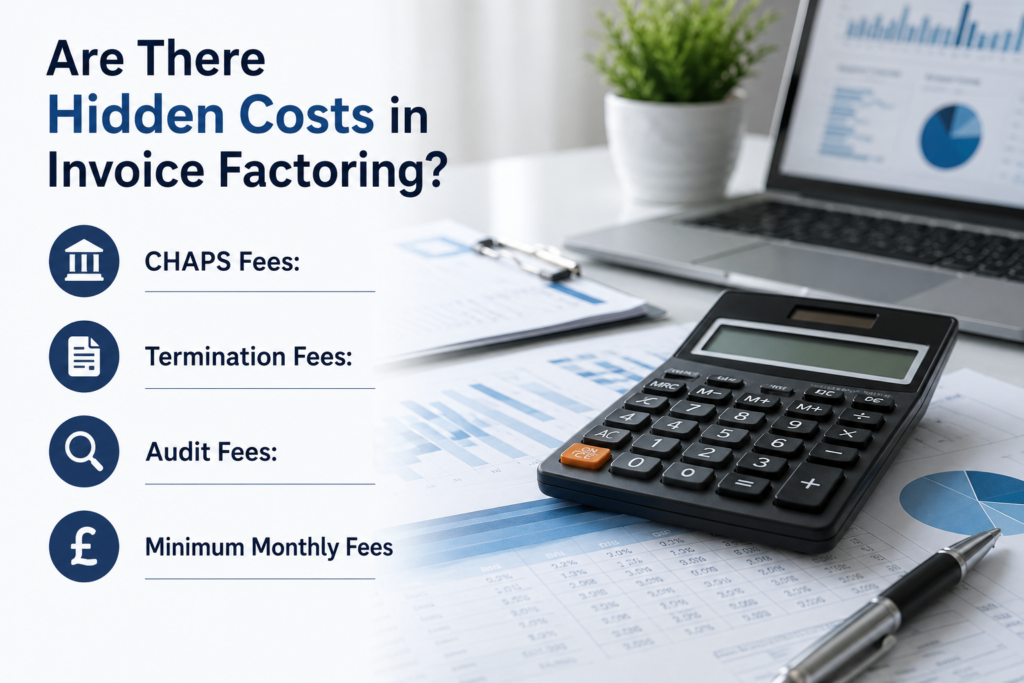
This is where things get tricky. While most reputable providers are transparent, “hidden” costs can sometimes lurk in the fine print. These aren’t necessarily “secret,” but they can catch you off guard if you aren’t looking for them. Common “extra” invoice factoring charges include:
- CHAPS Fees: Charges for same-day bank transfers.
- Termination Fees: If you want to leave your contract early, the exit costs can be high.
- Audit Fees: Some providers charge for a yearly or half-yearly audit of your books to ensure everything is in order.
- Minimum Monthly Fees: Even if you don’t use the facility much one month, you might still have to pay a minimum service charge.
Factoring vs Discounting Cost: Which is Cheaper?
When comparing factoring vs discounting cost, invoice discounting is almost always the cheaper option. Why? Because with discounting, you remain in charge of your own credit control. You do the chasing; you send the reminders.
Because the provider doesn’t have to hire staff to manage your ledger, the service fee for discounting is significantly lower.
However, discounting is usually only available to larger businesses with established credit control teams and higher turnovers. For a smaller business, the “extra” cost of factoring is often worth it because it saves you the time and headache of debt collection.
Is Factoring Expensive for Small Businesses?
This is a subjective question. If you look purely at the interest rate, yes, factoring is more expensive than a traditional bank loan. But for a small business, a bank loan might not even be an option.
When you weigh the invoice factoring cost against the benefits, like having immediate working capital to pay staff or take on a huge new contract, it often pays for itself.
It’s an investment in growth rather than just a “cost.” If it prevents you from missing a supplier payment or allows you to buy bulk materials at a discount, the facility can actually save you money in the long run.
How to Reduce Invoice Factoring Fees?
You don’t just have to accept the first quote you get. Here is how you can drive down your factoring fees in the UK:
- Improve Your Customers’ Credit: If you work with blue-chip companies or clients with great credit scores, the provider sees less risk and may offer a lower discount rate.
- Shop Around: Don’t just go to your high-street bank. Independent providers are often hungrier for your business and more flexible with their pricing.
- Increase Your Turnover: As your business grows and your turnover increases, you gain leverage to renegotiate lower percentage fees.
- Watch the “Extras”: Negotiate on things like setup fees or minimum monthly charges before you sign.
How Best Invoice Finance Helps
The sheer variety of finance provider fees in the UK can make your head spin. This is exactly why Best Invoice Finance exists. Instead of you spending days calling different lenders and trying to compare “apples to oranges,” they do the legwork for you.
Best Invoice Finance works as a specialist broker, matching your business needs with the right lender. We understand which providers have the lowest hidden costs and which ones offer the most competitive discount rates for your specific industry.
We help you strip away the jargon so you can see the true cost of factoring invoices before you commit.
Also Read:- Single Invoice Finance UK: How to Fund One Invoice Without Long-Term Contracts
Conclusion
Do not guess the invoice factoring cost on your own. If you want a transparent breakdown of how factoring can work for you without the “fee-shock,” reach out to the experts. Contact Best Invoice Finance today for a free, no-obligation cost comparison!
Ans:- Most businesses find that the total cost (service + discount) works out to roughly 1.5% to 5% of the total invoice value, depending on how long the customer takes to pay.
Ans:- The service fee usually applies to the whole invoice value, while the discount (interest) rate is only charged on the actual cash the lender has advanced to your bank account.
Ans:- Yes, if you choose “Invoice Discounting.” You’ll save on the service fee because you handle the debt collection yourself, but you’ll need to prove to the lender that your internal systems are up to scratch.
Ans:- If you have “Recourse Factoring,” you’ll have to pay the money back (or swap it for a different invoice). If you pay a bit extra for “Non-Recourse Factoring,” the lender takes the hit, acting like a form of credit insurance.
Ans:- The best way is to request a “Total Cost of Borrowing” breakdown. A broker like Best Invoice Finance can help you secure these transparent quotes so you can compare the true yearly cost between different lenders.
Discover the Latest Trends
Stay informed with our latest articles and resources.