Invoice Discounting Pros and Cons: Is It the Right Funding Option for Your Business?
Ever feel like your business is a high-performance sports car, but you’re constantly running on a nearly empty tank of gas? You’ve made the sales, the clients are happy, and the invoices are sent, but you’re still waiting 30, 60, or even 90 days, actually, to see the cash.
This is the “cash flow gap,” and it’s the number one reason even profitable businesses hit a wall. One of the most popular ways to bridge this gap in the UK is invoice discounting. But like any financial tool, it’s not a magic wand.
Let’s break down the invoice discounting pros and cons to see if it’s the right fuel for your business, and how it stacks up against invoice factoring for small business.
What is Invoice Discounting?
Think of invoice discounting as a series of short-term loans secured against your unpaid invoices. Instead of waiting for a customer to pay, Best Invoice Finance UK advances you a percentage of the invoice value (usually around 80-90%) almost immediately.
The biggest differentiator? You keep control. Unlike factoring, you still handle your own credit control and chase your own payments. To your customers, nothing has changed.
Invoice Discounting New Pros and Cons in 2026
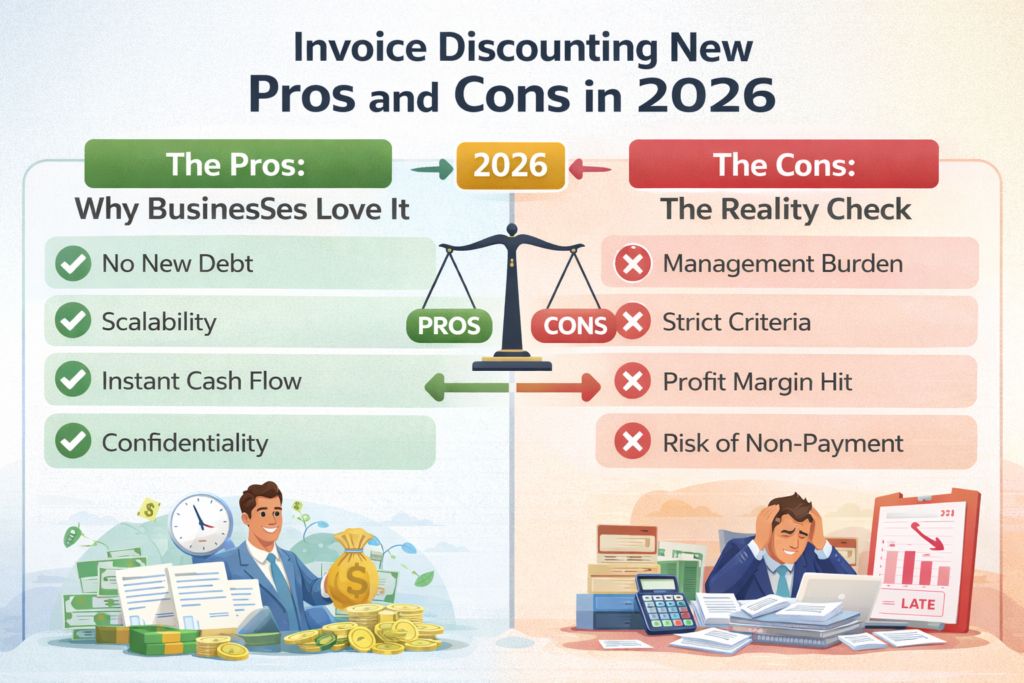
Choosing the right invoice finance solution requires weighing the immediate benefits against the long-term costs.
The Pros: Why Businesses Love It in 2026
- No New Debt: You aren’t taking on a traditional loan; you’re simply accessing money you’ve already earned.
- Scalability: Unlike a fixed bank loan, your funding grows with you. The more you sell, the more cash you can unlock. It’s perfect for rapidly growing companies.
- Instant Cash Flow: No more “waiting game.” You get paid within 24–48 hours of raising an invoice, allowing you to pay suppliers, meet payroll, or invest in new stock.
- Confidentiality: It is a huge win. Because you still manage the collections, your customers never need to know you’re using a finance facility. It keeps your professional image intact.
The Cons: The Reality Check
- Management Burden:– Since you’re still in charge of credit control, you need a solid internal finance team to chase those payments. If your admin is messy, this won’t fix it.
- Strict Criteria:– Lenders usually want to see a proven track record and a certain level of turnover (often £100k+ per year) before they’ll offer discounting.
- Profit Margin Hit:– There is always an invoice factoring cost or discounting fee. You’re trading a slice of your profit for the speed of cash.
- Risk of Non-Payment:– If your customer doesn’t pay, you’re usually still on the hook to repay the lender (it is called “recourse” finance).
Why “Best Invoice Finance UK” Stands Out in a Crowded Market
Not all finance providers are built the same. Some lenders treat you like a number in an algorithm, but Best Invoice Finance UK has earned its reputation by offering the best services tailored to the specific rhythm of British business.
We understand that a construction firm has different needs than a recruitment agency or a wholesaler. What sets us apart is the transparency regarding fees and the speed of our technology integration.
While some traditional banks take weeks to approve an invoice draw-down, we leverage modern platforms to get funds into your account almost instantly. If you are looking for a partner that balances competitive rates with a human touch, we are the standard for UK businesses.
Understanding The True Invoice Factoring Cost
When looking at Invoice Finance, don’t just look at the headline “discount rate.” To find the best deal with a provider like Best Invoice Finance UK, you need to look at the total package:
- Service Fee:– The “management fee” for the facility (usually 0.2% to 2.5% of turnover).
- Hidden Extras:– Watch out for “set-up fees,” “trust account fees,” or “annual renewal fees.”
- Discount Rate:– The “interest” on the money you actually draw down (typically 1% to 4% over the base rate).
The Hidden Impact on Supplier Relationships
One of the most overlooked aspects of the invoice discounting pros and cons list is how it ripples through your entire supply chain. When your cash is locked up in unpaid invoices, you become the “slow payer” to your own suppliers.
It can damage your reputation and prevent you from negotiating bulk discounts or early-payment incentives. By using invoice finance, you flip the script. Because you have immediate access to capital, you can pay your suppliers early.
In many cases, the 2-3% discount a supplier might give you for paying on the spot actually covers the entire cost. It transforms your finance department from a bottleneck into a tool for building stronger, more “premier” relationships with your vendors.
Also Read:- How to Choose Invoice Factoring for Small Businesses in 2026
Is it Right for You?
After comparing Invoice Discounting Pros and Cons, one can conclude that invoice discounting is ideal if you have a high volume of B2B invoices, and your customers are creditworthy. You have the internal resources to stay on top of your accounts.
If you’re tired of being the “bank” for your clients, it’s a game-changer. If you’re looking for the most competitive rates and a partner that understands the UK market, Best Invoice Finance UK offers the best services tailored specifically to bridge these gaps without the headache.
FAQs
Ans: Usually, no. Most discounting facilities are confidential, meaning you still send the invoices and collect the payments as normal.
Ans: The total discounting cost usually works out to between 1% and 5% of your invoice value, depending on your turnover and customer risk.
Ans: It’s tough. Most lenders want to see at least 6–12 months of trading history. For brand new businesses, “Spot Factoring” (financing one invoice at a time) is often the starting point.
Ans: Unless you have “Non-Recourse” protection, you will have to pay the advanced money back to the lender if the invoice becomes uncollectible.
Ans: Often, yes. Overdrafts are frequently capped and can be “called in” by the bank at any time. Invoice finance scales automatically as your sales grow.
Discover the Latest Trends
Stay informed with our latest articles and resources.