Invoice Factoring Cost: What You Really Pay and How to Reduce It | New Guide
When you’re running a business, “Cash is King” isn’t just a phrase; it’s a survival strategy. But waiting 30, 60, or even 90 days for a client to pay an invoice can feel like you’re moving through treacle. You’ve likely heard of invoice factoring as the “antidote” to slow-paying customers.
It sounds simple: you sell your invoice, get the cash today, and the factoring company chases the payment. But then comes the big question that keeps business owners up at night: “What is this actually going to cost me?”
The world of invoice factoring cost can be a bit of a labyrinth, filled with “service fees,” “discount rates,” and the occasional “hidden” charge that pops up like an unwelcome guest.
If you want to know what you’re really paying—and, more importantly, how to keep those costs down—pull up a chair. Here is the guide to the price of unlocking your cash flow.
The Two Pillars of Invoice Factoring Cost
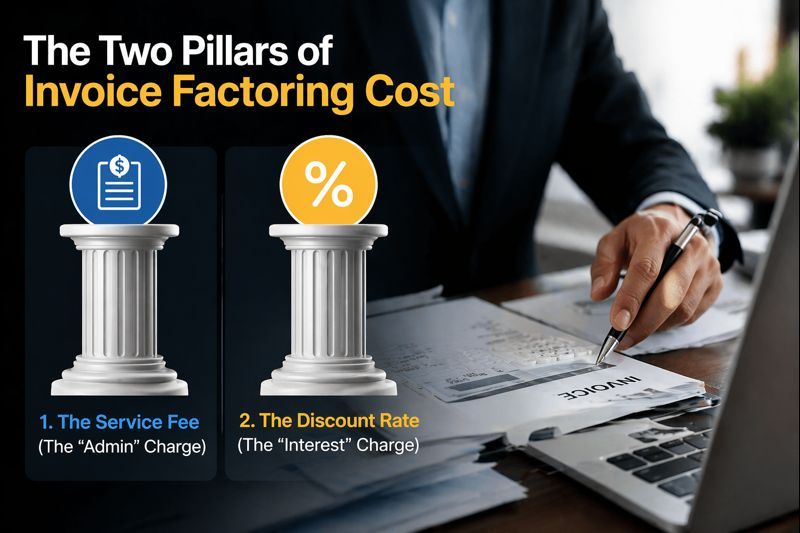
When you look at a quote for invoice factoring, the total price is usually split into two main buckets. Understanding these is the key to knowing if you’re getting a good deal.
1. The Service Fee (The “Admin” Charge)
It is essentially the fee for the “work” the factoring company does. Since factoring involves the provider taking over your credit control (chasing the late payers so you don’t have to), they charge a service fee to cover their overheads.
- Typical Range: Between 0.75% and 2.5% of your annual turnover.
- What influences it? If you have hundreds of small invoices, the fee will be higher because there’s more legwork. If you have five big invoices to blue-chip companies, it’ll be lower.
2. The Discount Rate (The “Interest” Charge)
It is the cost of borrowing the money. Think of it like the interest rate on a bank loan, but applied to the “advance” you receive.
- Typical Range: Usually 1.5% to 5% above the Bank of England base rate.
- How it works: It’s calculated daily. The faster your customer pays, the less you pay in discount fees. This is why having “slow payers” can quietly inflate your invoice factoring cost.
The “Sneaky” Extras: What Else Might You Pay?
Just like a budget airline, the base price isn’t always the final price. To avoid a “bill shock,” keep an eye out for these common add-ons:
- Setup/Arrangement Fees: A one-off cost to get the facility running (often £500–£2,000).
- Exit Fees: If you want to leave the contract early, some providers will charge a “breakage” fee.
- Credit Check Fees: Small charges every time the factor checks a new customer’s creditworthiness.
- CHAPS/Same-Day Transfer Fees: If you want the cash now (within hours), there’s often a small fee for the fast transfer.
How to Drastically Reduce Your Invoice Factoring Cost in 2026
The good news? You aren’t just a passenger here. There are several levers you can pull to make the facility much cheaper.
1. Improve Your Debtors’ Quality
- The factoring company assesses the risk based on your customers, not just you. If you trade with reputable, creditworthy businesses, the risk is lower, and your rates should follow suit.
2. Shorten Your Payment Terms
- Remember, the “Discount Rate” is charged daily. If you can nudge your customers from 60-day terms down to 30-day terms, you halve the interest part of your invoice factoring cost.
3. Diversify Your Customer Base
- Factoring companies get nervous if 90% of your business comes from one single client (it’s called “concentration risk”). Spreading your risk across multiple customers often leads to more competitive service fees.
4. Use a Specialist Partner
- Navigating 140+ UK lenders to find the cheapest rate is a full-time job. This is where Best Invoice Finance UK can be a literal lifesaver. Instead of you cold-calling banks, we use our industry connections to “shop around” for you.
Best Invoice Finance UK knows which lenders are currently hungry for business in your specific sector (like construction or recruitment) and can often negotiate “introductory” or “bulk” rates that you wouldn’t get going direct.
A Real-World Example: The “Daily Grind” of Costs
Let’s say you have a £10,000 invoice and your client usually takes 30 days to pay.
- Service Fee (1.5%): £150
- Discount Rate (Approx. 4% P.A. on an 85% advance): Around £28
- Total Cost: £178
In this case, you’ve paid less than 2% to get £8,500 in your pocket immediately. For many UK-based startups, that’s a small price to pay to keep the lights on and the staff paid.
Also Read:- Invoice Finance for Startups: How to Improve Cash Flow Without Loans
Conclusion
Managing your invoice factoring cost doesn’t have to be a headache. By understanding the difference between service fees and interest, and by focusing on your customers’ payment habits, you can turn this into one of the most cost-effective growth tools in your arsenal.
It’s all about transparency—knowing exactly what’s leaving your account so you can focus on what’s coming in.
FAQs
Q:- What are invoice factoring fees?
Ans:- Invoice Factoring Fees in the United Kingdom:-
- Advance Rate: Businesses typically receive 70% to 90% upfront of the invoice value.
- Factoring Fees (Discount Rate): Typically range from 1% to 5% per invoice per month, depending on risk and payment terms.
- Overall Cost Range: Most UK businesses pay around 3% to 8% of the total invoice value in factoring fees.
- Average Monthly Rate: Commonly 2% to 3% per 30 days for standard businesses with reliable customers.
- Service Fees: Usually 0.5% to 3% of annual turnover, covering administration and credit control.
- Setup Fees: One-time charges can range from £500 to £2,000, depending on the provider.
Q. Is invoice factoring more expensive than a bank loan?
Ans:- Usually, yes. But it’s much easier to get, grows as your sales grow, and includes a full credit control service, which saves you hiring an admin person.
Q. Does the invoice factoring cost change if my client pays late?
Ans:- Yes. The “Discount Fee” is daily, so if a client takes 90 days instead of 30, that portion of the cost will triple.
Q. Can I get a flat-fee deal?
Ans:- Some modern fintech providers offer “subscription” or flat-fee models, which can be great for budgeting, though they aren’t always the cheapest for high-volume businesses.
Q. What is the biggest factor in the cost?
Ans:- Your annual turnover. The higher your turnover, the lower the percentage the factor will charge as a service fee.
Q. How do I know if I’m being overcharged?
Ans:- Compare your quote! If you haven’t spoken to an expert like Best Invoice Finance UK to benchmark your rate against the current market, there’s a good chance you’re paying more than you need to.
Discover the Latest Trends
Stay informed with our latest articles and resources.