When Should You Use Selective Invoice Discounting Instead of Full Factoring?
Keeping cash flowing smoothly in a business can feel like a non-stop juggling act. You wrap up a major project, send off a perfectly polished invoice, and then… you wait. Sometimes for 30 days, sometimes 60, or even longer. Meanwhile, your own bills, payroll, and growth plans don’t exactly pause out of courtesy.
If you’ve started looking into business funding to fix this gap, you’ve probably run into the heavy hitters of the finance world: full invoice factoring and invoice discounting. But what if you don’t want to hand over your entire sales ledger to a lender? What if you only need a cash injection for a few specific, high-value invoices?
This is exactly where selective invoice discounting UK platforms come to the rescue. Let’s break down how this flexible tool works, compare invoice discounting and invoice factoring, and look at when it makes the most sense for your business.
Can I Choose Which Invoices to Finance in the UK?
Yes! Traditional invoice financing usually forces you into an “all-or-nothing” commitment. When you sign up for full factoring or standard discounting, you are generally expected to run your entire sales ledger through the lender for 12 to 24 months.
Selective invoice finance UK facilities tear up that old rulebook. Instead of locking in your whole business, you get to pick and choose exactly which invoices or specific client accounts you want to fund. It gives you total control over your working capital without tying you down to long-term ledger restrictions.
When is Selective Invoice Discounting Better Than Factoring?
To understand when selective discounting takes the crown, it helps to look at how it differs from a traditional factoring setup. With full factoring, the provider doesn’t just advance your cash; they also take over your credit control.
Their team will actively call and email your customers to chase down payments. While that sounds helpful, it means your clients will immediately know you are using a finance provider. For some businesses, that’s completely fine. For others, it can feel a bit uncomfortable. Selective invoice discounting UK is different for two main reasons:
- Complete Confidentiality: Your customers have no idea a finance company is involved. You continue to manage your own credit control, send out reminders, and collect payments exactly as you always have.
- Pay-As-You-Go Freedom: You only activate the facility when you actually need it. If you have a comfortable cash cushion this month, you don’t use it, and you don’t pay for it.
Because of this combo, selective invoice discounting in UK is much better when you have a strong internal finance process, value client privacy, and only face occasional, project-based cash gaps rather than a permanent shortfall.
Who Should Use Selective Invoice Discounting in UK?
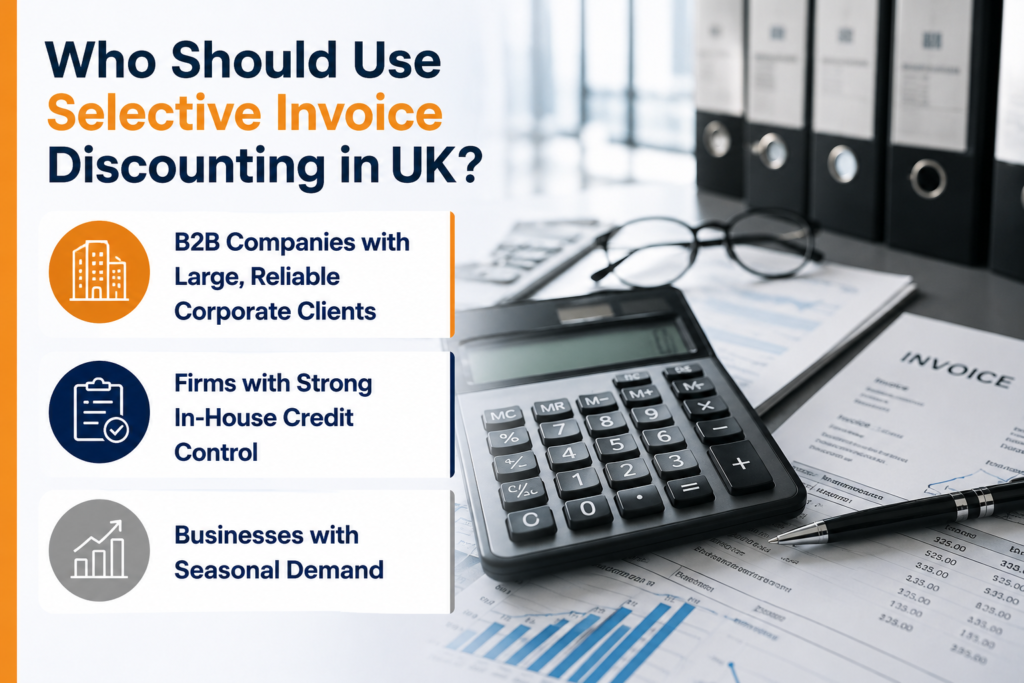
This financial strategy isn’t a one-size-fits-all solution, but it is incredibly powerful for specific business models. You are likely the perfect candidate if you fit into these brackets:
- B2B Companies with Large, Reliable Corporate Clients: If you work with blue-chip companies or government bodies that take 90 days to pay but are guaranteed to settle the bill, selective discounting lets you safely unlock that trapped cash early.
- Firms with Strong In-House Credit Control: Because the lender leaves the debt collection to you, you need to have an organised team capable of chasing payments professionally and on time.
- Businesses with Seasonal Demand: If your revenue spikes sharply during certain months, you might only need extra funding to survive the slow periods or ramp up inventory ahead of a rush.
Cost Breakdown: Is Selective Invoice Finance Cheaper Than Full Factoring?
On a purely transactional level, full factoring often carries higher service fees because you are paying for the lender’s staff to manage your collections. With selective discounting, you handle the admin, which keeps the individual service fees lower.
However, because selective finance is a “pay-as-you-go” style product, lenders might charge a slightly higher interest margin on the specific cash they advance to balance out their risk.
If you only need to fund a handful of invoices a year, selective invoice discounting UK options will be vastly cheaper overall because you completely avoid the ongoing monthly maintenance fees of a full-facility contract.
How Best Invoice Finance Helps You Navigate the Market
Finding the right lender can feel like a full-time job in itself, and a wrong move can lock you into restrictive terms. That’s where working with an independent specialist like Best Invoice Finance makes a massive difference.
Instead of trying to squeeze your business into a rigid, off-the-shelf product, Best Invoice Finance helps UK businesses compare top commercial lenders to find a perfectly tailored layout.
Whether you need a confidential selective facility to protect a sensitive client relationship or a flexible cash bridge for an upcoming project, they cut through the jargon to secure the best rates and terms for your specific setup.
Also Read:- Invoice Discounting for Businesses: How It Works & Why UK Companies Use It
Conclusion
Finding the right working capital balance doesn’t require rigid, long-term contracts. Embracing selective invoice discounting UK options gives you the ultimate control to unlock trapped cash on your own terms, protecting your vital client relationships while keeping your business moving smoothly.
Ans: No. Unlike full factoring, selective invoice discounting is completely confidential. You handle all customer communications and debt collection yourself, so your clients won’t notice any change.
Ans: No, funding providers usually advance a fixed, pre-agreed percentage of the total invoice value (typically between 80% to 95%), rather than a custom partial amount.
Ans: Not standardly. Unless you specifically opt for a non-recourse facility, your business remains responsible for the cash advance if a customer defaults on their invoice.
Ans: Once your account is set up with a provider, approved individual invoices can often be turned into working capital within 24 hours of submission.
Ans: No. Because you aren’t financing your whole ledger, entry requirements are usually much lower and more flexible than full-facility discounting plans.
Discover the Latest Trends
Stay informed with our latest articles and resources.