Invoice Discounting Rates in the UK: What Businesses Really Pay & How to Reduce Costs
Running a business in the UK right now feels a bit like trying to sprint through a swimming pool. You’ve got the sales, the team is crushing it, but that “cash flow” gap, the 30, 60, or 90 days you wait for clients to pay, can feel like a literal anchor.
If you’ve looked into bridge funding, you’ve likely stumbled across invoice discounting rates. But what do those numbers actually mean for your bottom line? Let’s pull back the curtain on what UK businesses are really paying and how to keep those costs from spiraling.
What are Typical Invoice Discounting Rates in the UK?
In the UK market, the cost of invoice discounting isn’t just one flat number. It’s usually split into two distinct parts:
- The Service Fee (Admin Fee): This covers the management of the facility. It usually ranges from 0.2% to 0.5% of your annual turnover.
- The Discount Rate (Interest): This is the “interest” you pay on the money you actually draw down. Usually, it sits between 1% and 4.5% above the Bank of England base rate.
So, if the base rate is 5% and your margin is 2%, your total invoice discounting rates would be around 7% annually on the funds you use.
How Much Does Invoice Discounting Cost Per Invoice?
Many business owners prefer to think in terms of individual transactions. If you’re looking at it that way, you can expect to pay anywhere from 1% to 5% of the total invoice value.
For example, if you have a £10,000 invoice and your total agreed-upon rate is 3%, you’re looking at a £300 cost to get that cash immediately rather than in 2 months. Compared to other business funding costs, like credit cards, it is often a much more sustainable way to grow.
What Affects Invoice Finance Rates for Businesses?
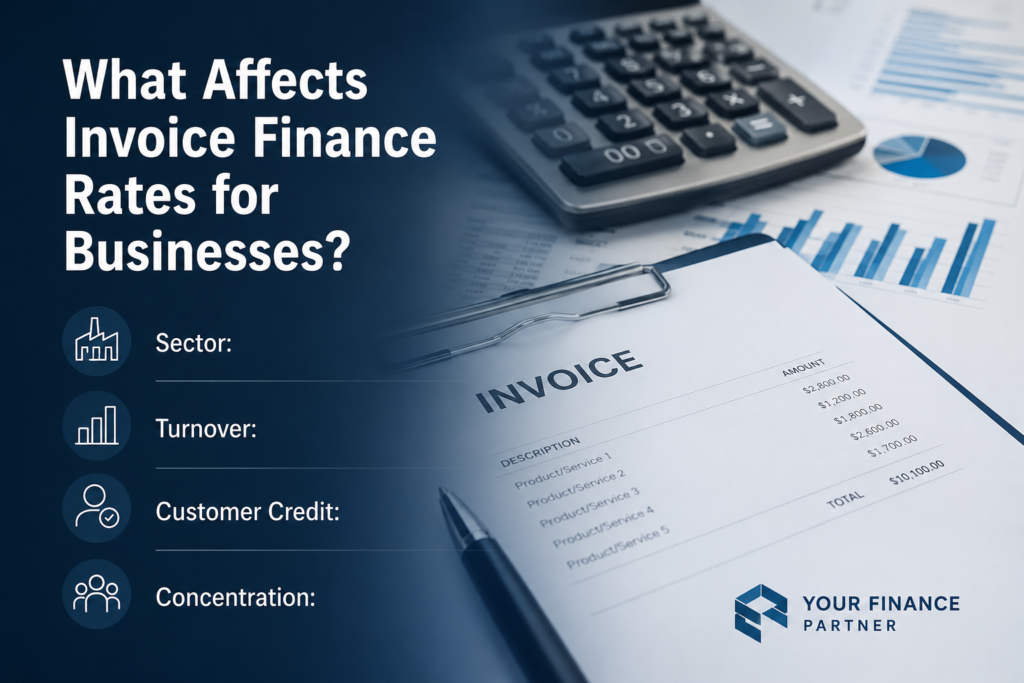
Lenders don’t just pull numbers out of a hat. When they calculate your invoice finance rates UK, they are looking at risk. Several things will move the needle:
- Sector: Some industries are seen as “safer” than others.
- Turnover: The more you invoice, the lower your rates usually go (economies of scale!).
- Customer Credit: If you work with blue-chip companies or government bodies, your rates will be lower because the lender knows they’ll get paid.
- Concentration: If 90% of your business comes from one client, the risk is higher, which might bump up your discount rates factoring, or discounting fees.
Is Invoice Discounting Cheaper Than Factoring?
Generally, yes. Invoice discounting is almost always cheaper than factoring. Why? Because with discounting, you keep control of your sales ledger and do your own credit control.
Since the lender doesn’t have to hire staff to chase your customers for payment, they pass those savings on to you.
While asset finance rates in UK are competitive for purchasing equipment, for pure cash flow, discounting remains the “leaner” option for established businesses with their own accounts teams.
Slashing the Bill: Are Invoice Discounting Fees Negotiable?
Absolutely. The UK invoice finance market is incredibly competitive. Lenders are often willing to budge on the service fee or the discount margin to win your business.
However, you need leverage. This is where having a clear financial history and a solid “debtor book” (the list of people who owe you money) comes in handy.
How to Reduce Your Costs:
- Shop around: Don’t just go to your high-street bank.
- Improve your credit control: If you show you’re great at collecting money, lenders see less risk.
- Use a broker: Professional intermediaries can often access “hidden” rates you won’t find on a public website.
How Best Invoice Finance Can Help
Navigating the world of invoice discounting rates can feel like a full-time job. That’s where Best Invoice Finance comes in.
We specialise in matching UK businesses with the right lenders, ensuring you don’t just get “a” rate, but the best rate for your specific industry and turnover.
Instead of calling twenty banks yourself, they do the heavy lifting to find the most cost-effective business funding cost structure for your goals.
Also Read:- Invoice Finance Facility Explained: How UK Businesses Unlock Cash Without Taking on Debt
Conclusion
Ultimately, mastering your invoice discounting rates is about more than just shaving off a fraction of a percent; it’s about unlocking the agility your business needs to thrive.
While the cost of invoice discounting can vary based on your sector and turnover, it remains one of the most flexible tools in the UK’s asset finance rates landscape.
By keeping your credit control tight and leveraging experts like Best Invoice Finance, you can ensure your business funding cost stays an investment in growth rather than a drain on profits. Don’t settle for the first quote—negotiate, optimise, and keep your cash flow moving.
Ans:- Beyond the headline rates, look out for “disbursement fees,” “audit fees,” or “minimum monthly charges.” These can sneakily increase your overall funding cost if you aren’t careful when reviewing your contract.
Ans:- Since most invoice finance rates are pegged to the base rate (e.g., Base + 2%), your costs will fluctuate. When the central bank raises rates, your borrowing cost goes up automatically, making it vital to monitor your margins.
Ans:- Yes! As your turnover grows, you gain more “buying power,” which often allows you to renegotiate your service fee significantly lower than when you were a smaller startup.
Ans:- This is called “Selective” discounting. While it offers more freedom, keep in mind that the discounting rates for selective facilities are usually higher than for a whole-ledger facility.
Ans:- While discounting funds your sales, asset finance rates apply to borrowing against physical tools or vehicles. Many businesses use both, discounting for monthly cash flow and asset finance for long-term equipment, to balance their total debt profile.
Discover the Latest Trends
Stay informed with our latest articles and resources.