Invoice Finance Facility Explained: How UK Businesses Unlock Cash Without Taking on Debt
Running a business in the UK often feels like a balancing act. You’ve done the work, delivered the goods, and sent off the invoice, but then comes the wait. Whether it’s 30, 60, or even 90 days, that “paper profit” doesn’t help you pay your staff or stock your shelves today.
This is where an invoice finance facility UK businesses rely on, comes into play. It’s a way to bridge the gap between completed work and actual cash in the bank, and the best part? It isn’t a traditional debt in the way a bank loan is. Let’s dive into how this works and why it might be the secret weapon your cash flow needs.
What is an Invoice Finance Facility in the UK?
At its simplest, an invoice finance facility meaning refers to a revolving line of credit that is secured against your unpaid B2B invoices. Instead of waiting for a customer to pay, a finance provider “buys” the debt from you or lends against it, giving you immediate access to the value of your sales ledger.
In the UK, this is a massive industry. It is specifically designed for businesses that sell to other businesses (B2B) rather than the general public. Think of it as a way to unlock your own money that is currently trapped in your accounts receivable.
How Does an Invoice Finance Facility Work for Small Businesses?
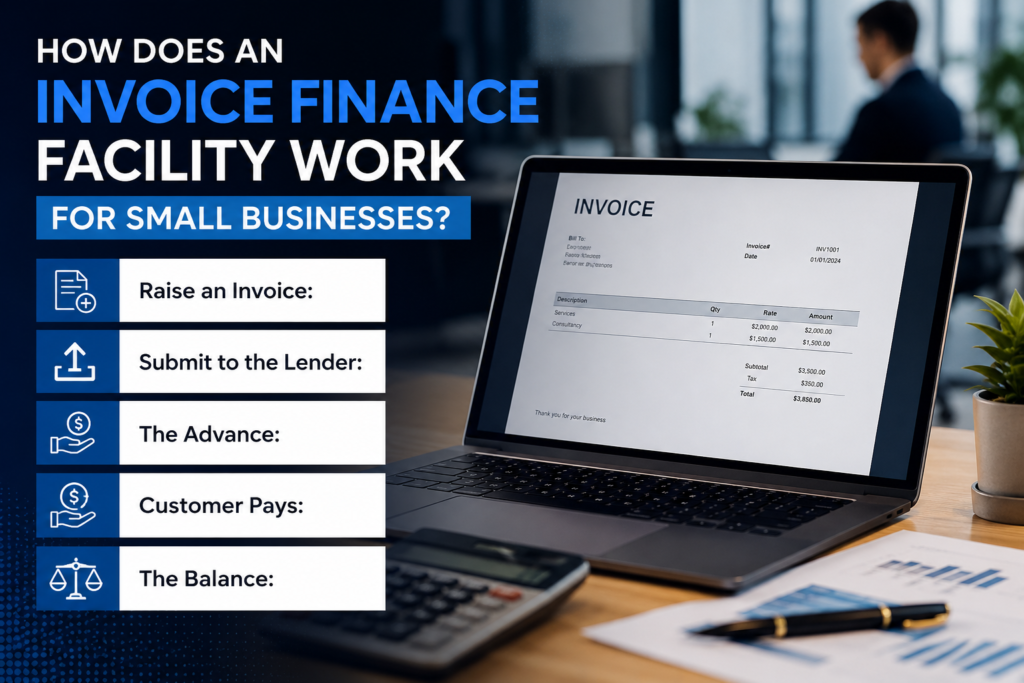
The process is surprisingly simple. If you are wondering how invoice finance facility works UK style, here is the typical step-by-step:
- Raise an Invoice: You provide a service or product to your customer and send them an invoice as usual.
- Submit to the Lender: You send a copy of that invoice to your finance provider.
- The Advance: Within 24 hours, the lender sends you a percentage of the invoice value, typically between 80% and 90%.
- Customer Pays: Your customer pays the invoice according to their original terms.
- The Balance: The lender sends you the remaining 10% to 20%, minus a small service fee.
For a small business, it is a game-changer. It means you can take on larger contracts without worrying if you have enough cash to buy raw materials or pay subcontractors while waiting for the previous job to settle.
Is Invoice Finance Considered a Loan in the UK?
Technically, no. While it provides you with cash, it is categorised as asset-based finance. When you take out a traditional loan, you are borrowing money you haven’t earned yet and agreeing to pay it back over time with interest.
With an invoice finance facility UK, you are essentially selling an asset for a small discount. As it’s based on the strength of your customers’ ability to pay, rather than just your own credit score, it’s often much easier for growing businesses to access than a standard bank loan.
How Best Invoice Finance Helps You Navigate the Market
Choosing the right provider can be overwhelming. This is where a service like Best Invoice Finance becomes invaluable. We act as a specialist broker to help UK businesses find the most competitive rates and the right “fit” for their industry.
Whether you need Factoring (where the lender handles the collections) or Invoice Discounting (where your customers never know you’re using it), Best Invoice Finance compares the market to ensure you aren’t paying over the odds in hidden fees.
Our expertise ensures that the facility scales with you, as your sales grow, your available cash grows automatically.
What are the Costs of Invoice Finance Facilities in the UK?
If you’re considering this, you’re likely asking: Generally, you’ll encounter two main charges:
- The Service Fee: It covers the administration of the facility. It’s usually a small percentage of your annual turnover (often between 0.5% and 3%).
- The Discount Charge: It is similar to an interest rate, charged only on the money you actually draw down. In 2026, this typically sits around 2% to 4.5% above the Bank of England base rate.
Also Read:- Finance Lease Agreement UK: Key Terms, Hidden Clauses, and What Businesses Must Check
The Bottom Line: Why it Makes Sense
At the end of the day, an invoice finance facility UK isn’t about being in financial trouble; it’s about empowerment. It turns your sales ledger into a live, breathing source of capital that grows exactly at the same pace as your ambition.
By working with Best Invoice Finance, you can strip away the complexity and find a deal that keeps your bank balance healthy and your focus where it belongs: on growing your business. Instead of checking your bank account every morning, hoping a client has finally paid, you can get back to what you do best.
Ans:- Speed is the biggest perk! Once the facility is set up, most providers will deposit the cash into your account within 24 hours of you uploading a new invoice. Some modern AI-driven platforms can even do it in minutes.
Ans:- Factoring includes a professional credit control service where the lender collects payments for you. Invoice Discounting is confidential, meaning you keep control of your sales ledger and your customers remain unaware of the facility.
Ans:- Yes, most lenders cap the amount you can borrow against a single client to spread risk. If you have one major customer, Best Invoice Finance can help find lenders willing to offer higher concentration limits.
Ans:- “Recourse” means you are responsible for the debt if your customer doesn’t pay. “Non-Recourse” includes credit insurance, protecting your business if a customer becomes insolvent or defaults.
Ans:- With Factoring, the lender interacts with your clients for collections, which is standard in many UK industries. With Invoice Discounting, the process is entirely invisible to your customers, preserving your direct relationship.
Discover the Latest Trends
Stay informed with our latest articles and resources.