Invoice Discounting Facility in the UK: How It Works, Costs, and How to Get Approved Fast
When your business is booming, but your bank account is bone dry, it usually means one thing: your cash is trapped in unpaid invoices.
In the UK, this “late payment” culture costs the economy billions, but for an individual business owner, it’s a personal headache that can stall growth.
Enter the invoice discounting facility. It is the “discreet older sibling” of invoice factoring, a way to unlock your own money without having to tell your clients you’re doing it.
How Does an Invoice Discounting Facility Work in the UK?
Think of an invoice discounting facility as a revolving line of credit secured by your sales ledger. Unlike a traditional loan, where you get a lump sum and pay it back over years, this facility grows and shrinks with your sales.
- Raise an Invoice: You finish a job for a client and send them an invoice with 30, 60, or 90-day terms.
- Upload the Details: You send a copy of that invoice to your finance provider.
- The Advance: Within 24 to 48 hours, the lender “advances” you a percentage of that invoice, usually between 80% and 90%.
- Business as Usual: You continue to chase the payment yourself. Your client pays into a “trust account” (which looks like your regular business account to them).
- The Settlement: Once the client pays, the lender takes back the advanced amount plus their fees, and sends you the remaining 10% to 20% (the “reserve”).
What are the Fees for an Invoice Discounting Facility?
As you manage your own credit control (chasing the payments), invoice discounting is generally cheaper than factoring. However, you should look out for two primary invoice discounting fees and charges:
- The Service Fee: It is an admin charge for managing the facility. It is usually a percentage of your annual turnover, typically ranging from 0.2% to 1.0%. Even if you don’t draw down funds, there might be a monthly minimum.
- The Discounting Fee (Interest): It is the interest charged on the actual cash you’ve drawn down. In 2026, UK rates typically hover between 2% and 5% above the Bank of England base rate.
- Hidden Extras: Always check for setup fees, “refactoring” fees for late invoices, or exit fees if you decide to leave the contract early.
What Businesses are Eligible for Invoice Discounting in the UK?
Not every business can walk into an invoice discounting facility UK. Because the lender is trusting you to collect the money, they have stricter requirements than they do for factoring.
- B2B Only:– You must sell to other businesses on credit terms. B2C (selling to the public) usually isn’t eligible.
- Strong Credit Control:– You need a proven track record of successfully collecting payments from your clients.
- Financial Stability:– You typically need to have been trading for at least 6–12 months with clean accounting records (Xero or Sage integration is a huge plus).
- Minimum Turnover:– Most UK lenders look for a turnover of at least £100,000 to £500,000, though some fintech challengers have lowered this bar recently.
Is Invoice Discounting Better Than a Business Loan?
The debate between invoice discounting vs a business loan usually comes down to what you need the money for.
| Feature | Invoice Discounting Facility | Traditional Business Loan |
| Scalability | Limits grow automatically as your sales grow. | Fixed amount; you must reapply to get more. |
| Commitment | Pay only for what you use. | Fixed monthly repayments regardless of cash flow. |
| Security | Secured by your invoices (accounts receivable). | Often requires personal guarantees or property. |
| Speed | Initial setup takes a week; cash then arrives in 24 hours. | Can take weeks of bank bureaucracy. |
The Verdict:– If you’re buying a new warehouse, get a loan. If you need to pay staff and suppliers while waiting for a big client to pay, invoice discounting is the winner.
Also Read:- How Invoice Factoring Solves Cash Flow Gaps for UK Businesses
How Can I Get Approved for Invoice Discounting Quickly?
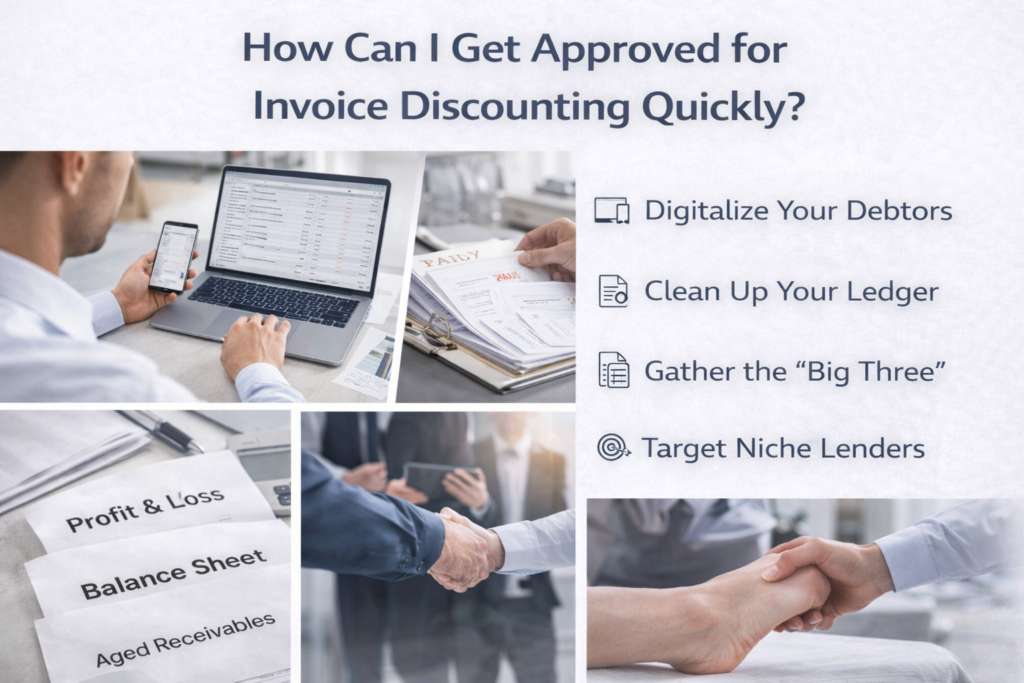
If you’re wondering how to get invoice discounting without the month-long wait, follow these steps to get approved for invoice discounting quickly:
- Digitalize Your Debtors: Use cloud accounting software. Most modern UK lenders use “Open Banking” and API integrations to see your ledger instantly.
- Clean Up Your Ledger: Get rid of “bad debts” (invoices over 90 days late) before applying. Lenders want to see a healthy, active list of customers.
- Gather the “Big Three”: Have your last 6 months of bank statements, your latest year-end accounts, and an up-to-date “Aged Debtors” report ready.
- Target Niche Lenders: Traditional high-street banks are slow. Look for specialized invoice finance brokers or fintech platforms like Bibby, Novuna, or Aria, which can often give an “in-principle” decision in hours.
FAQs
Q. Is invoice discounting confidential?
Ans:- Yes. Unlike factoring, your customers never know a third party is involved. You remain the point of contact for all payments.
Q. Can I use it for just one or two invoices?
Ans:- While a full facility covers your whole ledger, you can look for “Spot” or “Selective” invoice discounting if you only want to fund specific high-value invoices.
Q. What happens if a customer doesn’t pay?
Ans:- Usually, the invoice is “recourse,” meaning you have to pay the lender back. However, you can opt for “Non-Recourse” discounting, which includes bad debt protection.
Q. How long does the setup take?
Ans:- Most UK providers can set up a full facility in 5 to 10 working days, provided your accounts are digital and up-to-date.
Q. Does it affect my credit rating?
Ans:- Actually, it can improve it. By having consistent cash flow to pay your own suppliers on time, your business credit score often sees a positive bump.
Final Thoughts
An invoice discounting facility by Best Invoice Finance is a powerful tool for UK SMEs that want to maintain control and confidentiality while fixing their cash flow. It turns your invoices from “money you’re owed” into “money you have,” giving you the fuel to take on larger contracts and grow with confidence.
Discover the Latest Trends
Stay informed with our latest articles and resources.