What Happens After You Apply for Invoice Finance? Full Process Explained
Raising a bunch of invoices for your hard work feels great, until you realise you have to wait 30, 60, or even 90 days actually to see that cash in your bank account. This “paper wealth” is the silent killer of many growing businesses. This is where the invoice finance process steps in to turn those pieces of paper into immediate working capital.
But if you’ve never used it before, the “what happens next” part can feel like a black box. Are they going to call all your customers? Is it going to take weeks? Let’s walk through the full business funding process, from hitting ‘apply’ to seeing the funds land in your account.
What Happens After Applying for Invoice Finance?
Once you submit your initial application, you aren’t just left waiting in the dark. The very first thing that happens is an initial consultation. A specialist from a firm like Best Invoice Finance will usually reach out to understand your business model. They aren’t just looking at your credit score; they are looking at the quality of your “debtor book”, the people who owe you money.
After the chat, the lender performs a “Business Health Check.” They’ll review your sales ledger to ensure your invoices are valid and that your customers have a solid track record of paying on time. It is a collaborative phase where the lender makes sure the facility size actually matches your growth ambitions.
The 4 Key Seps of Invoice Finance Process
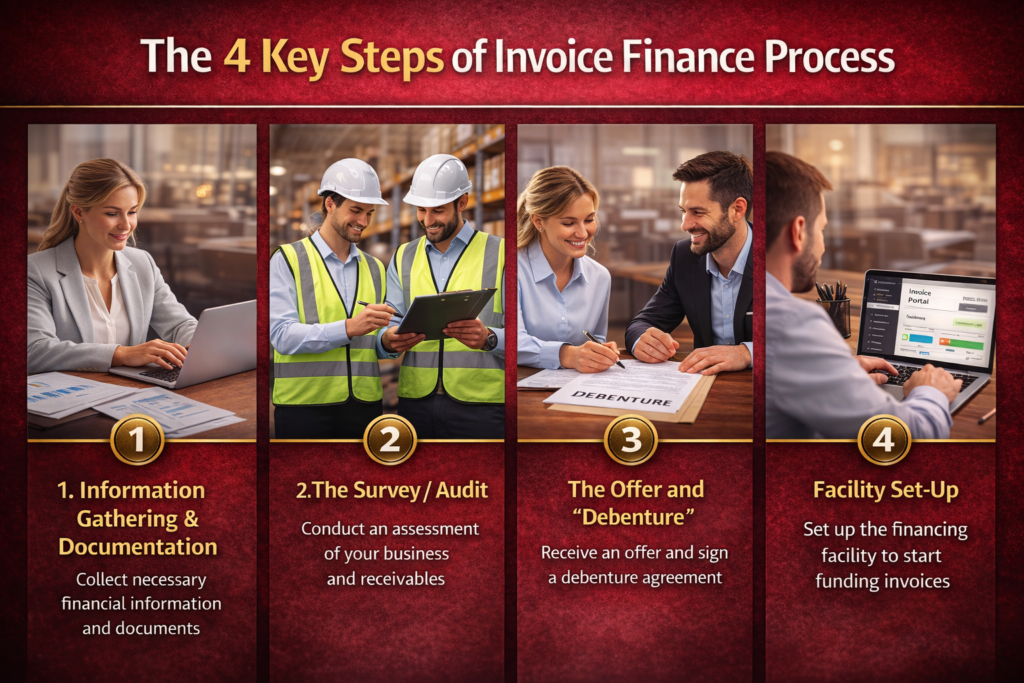
Understanding the invoice finance timeline is easier when you break it down into these four logical stages:
1. Information Gathering & Documentation
- You’ll provide your recent accounts and a list of your current outstanding invoices. Modern providers often use “Open Banking” or integrate directly with software like Xero or QuickBooks to make this almost instant.
2. The Survey / Audit
- For larger facilities, the lender might perform a “survey.” Don’t let the word scare you; it’s just a verification process to check your invoicing procedures, proof of delivery, and contracts.
3. The Offer and “Debenture”
- Once they are happy, you’ll receive an offer letter. It outlines your “advance rate” (usually 80% to 95%) and the fees. At this stage, a “debenture” is registered at Companies House, which is a standard legal notice showing the lender has a prioritized interest in your accounts receivable.
4. Facility Set-Up
- Your account is created on the lender’s portal. You upload your invoices, and the system calculates exactly how much cash you can draw down immediately.
How Invoice Factoring Works vs Discounting Works
A common question in the invoice finance process is whether your customers will know you’re using it.
- Factoring:– The lender manages your credit control. They’ll send the reminders and collect the payments. It’s great for smaller teams who don’t want the hassle of chasing late payers.
- Invoice Discounting:– This is confidential. You keep chasing the payments yourself, and your customers are none the wiser. It is often the preferred business funding process for established firms with their own accounts teams.
What Checks Do Lenders Perform?
Unlike a traditional bank loan, the funding approval process for invoice finance is “asset-backed.” The main checks include:
- Customer Creditworthiness:– Lenders check the credit strength of your clients. If you work with blue-chip companies or government bodies, your approval is much faster.
- Director History:– They’ll look at your track record as a business owner, but a bumpy past isn’t necessarily a deal-breaker if your current invoices are solid.
- Verification of Debt:– They may call a few customers to confirm that the goods were received and the invoice is undisputed.
Also Read:- Growing Too Fast? How Invoice Finance Supports Business Expansion Without Cash Shortage
Why Best Invoice Finance?
Choosing a partner is about more than just the lowest rate. Best Invoice Finance specialises in matching UK businesses with the specific type of facility they need, whether that’s selective “spot” factoring for a single big contract or a whole-ledger discounting facility for a multi-million-pound turnover company.
Our expertise lies in smoothing out the invoice finance timeline, ensuring you aren’t stuck in bureaucratic limbo when you have a payroll to meet or a new supplier to pay.
Conclusion
The invoice finance process is designed to be a “living” facility that grows as your sales grow. Unlike a fixed loan, the more you invoice, the more funding becomes available.
By understanding these invoice finance steps, you can move from application to your first drawdown with total confidence, knowing exactly who is doing what and when that cash will hit your balance sheet.
FAQs
Q:- How long does invoice finance approval take?
Ans:- In 2026, the digital invoice finance timeline has shrunk significantly. Initial approval can happen within 24 to 48 hours, and once the facility is set up, individual invoices can often be funded in under 4 hours.
Q:- When do you receive the funds?
Ans:- You receive the “advance” (e.g., 90%) as soon as the invoice is verified. The remaining 10% (minus the lender’s fee) is paid to you once your customer settles the full bill.
Q:- What documents are required for availing invoice finance?
- Recent financial accounts (P&L and Balance Sheet).
- Sample invoices with proof of delivery/completion.
- An up-to-date aged debtor report.
- Proof of ID for directors.
Q:- Can I use invoice finance for one-off projects?
Ans:- Yes! It is called “Spot Factoring” or “Selective Invoice Finance.” You don’t have to commit your whole ledger; you can just choose the specific invoices that are causing a cash flow squeeze.
Q:- How does it affect my customer relationships?
Ans:- If you choose Invoice Discounting, it has zero effect because it’s confidential. If you choose Invoice Factoring, the lender handles collections professionally, often acting as an extension of your own accounts department to maintain a positive relationship with your clients.
Discover the Latest Trends
Stay informed with our latest articles and resources.